

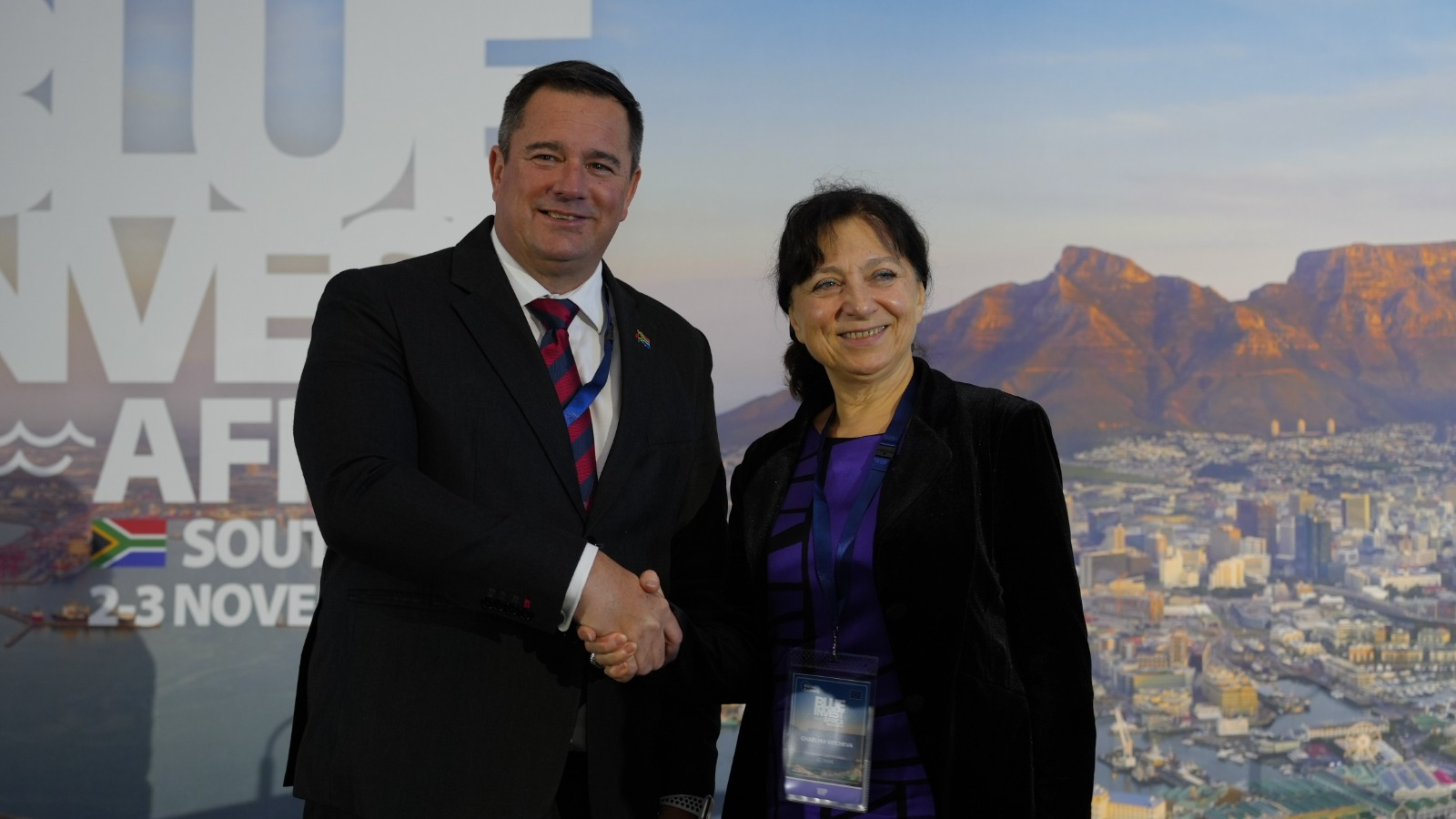
Cape Town Emerges as a Strategic Meeting Point for Capital, Innovation, Maritime Trade and Africa’s Blue Economy
Cape Town, South Africa | 2 November 2026
For decades, Africa’s oceans have been described primarily in terms of their untapped potential.
That language is beginning to change.
The BlueInvest Africa South Africa 2026 gathering in Cape Town is providing a powerful indication that the continent’s blue economy is increasingly being viewed not simply as an environmental or maritime issue, but as a serious economic, industrial, investment and regional-trade opportunity.
Taking place on 2–3 November in Cape Town, the fourth edition of BlueInvest Africa brings together entrepreneurs, investors, policymakers, development institutions, innovators and strategic partners from Africa and Europe around a common objective: turning Africa’s blue-economy innovation into investable businesses and scalable economic opportunities.
And perhaps more importantly, the conversation taking place in Cape Town is connecting several issues that are too often treated separately: investment, maritime logistics, industrialisation, sustainability, climate resilience, regional integration, technology and trade.
From potential to bankable opportunity
Deputy Minister of Trade, Industry and Competition Hon John Steenhuisen, addressing the conference in Cape Town, made the central economic argument clearly: Africa's blue economy is no longer simply an opportunity for the future; it represents an investment opportunity today.
According to the South African government, Africa’s blue economy is already estimated to contribute approximately €350 billion to the continent’s economy, with opportunities extending across fisheries, aquaculture, maritime transport, ports and logistics, marine manufacturing, tourism, energy, biotechnology and ocean science.
But the critical question is not whether opportunities exist.
It is whether Africa can turn those opportunities into bankable projects capable of attracting capital, creating businesses, generating jobs and building regional value chains.
That distinction is fundamental.
Africa does not suffer from a shortage of ideas. It has entrepreneurs, natural resources, young populations, technology and enormous markets.
The challenge is increasingly one of investment readiness, commercialisation, infrastructure, market access and execution.
That is precisely where BlueInvest Africa becomes strategically relevant.
The programme was created by the European Union to connect African entrepreneurs seeking finance with international investors looking for sustainable blue-economy opportunities. The 2026 edition selected 24 ventures from hundreds of applications originating in 38 African countries, with businesses operating across areas including aquaculture, fisheries, waste-to-value, marine technology, packaging, robotics, maritime services and environmental solutions.
This is therefore not merely a conference.
It is increasingly becoming a marketplace for African innovation and international capital.
The geopolitical significance of the ocean
Perhaps one of the most important themes emerging from Cape Town is that the blue economy cannot be separated from the changing architecture of global trade.
Hon Steenhuisen positioned the sector within a world experiencing increasing protectionism, geopolitical uncertainty and fragmentation of international trade.
His argument was that Africa has an opportunity to demonstrate the value of cooperation precisely at a time when global economic relationships are becoming more fragmented.
The Southern African Development Community, the African Continental Free Trade Area and stronger Africa–European Union relations therefore become particularly important.
The question is no longer simply:
What can Africa export?
The bigger question is:
How can African countries build interconnected regional value chains that allow more of the value created by African resources, production and innovation to remain on the continent?
That is where the blue economy becomes much bigger than fisheries or shipping.
It becomes a conversation about industrial policy, trade, infrastructure, manufacturing, technology and capital.
The Cape of Good Hope is becoming strategically important again
EU Ambassador to South Africa Kristian Schmidt highlighted another development with major implications for the region: increasing maritime traffic around the Cape of Good Hope.
The changing global shipping environment is creating both opportunities and risks.
More maritime traffic around the southern African coastline creates potential opportunities in logistics, port infrastructure, ship repair, marine services, green shipping and associated industries.
But opportunity without infrastructure can become a constraint.
The challenge therefore becomes how South Africa and its neighbours can position the region not merely as a geographical passage for international shipping, but as a competitive maritime economic corridor.
That distinction could prove extremely important.
Africa should not aspire merely to have ships pass around its coastline.
It should aspire to capture economic value from the movement of those ships.
That means developing ports, logistics, shipbuilding, repair, bunkering, marine services, technology, training, insurance, financing and supporting industries.
South Africa already has capabilities to build upon
South Africa's opportunity is particularly significant because the country is not starting from zero.
Steenhuisen pointed to South Africa’s established shipbuilding capabilities, including the production of yachts, tugboats and patrol vessels through partnerships with European counterparts.
In 2025, South Africa exported more than R5.7 billion worth of ships, compared with R2.5 billion in 2016. The government now sees an opportunity to position South Africa as a shipbuilding partner for the rest of the continent.
This presents a potentially powerful regional-industrialisation opportunity.
Instead of individual African countries attempting to build isolated maritime capabilities, the continent could develop complementary regional capacities.
One country may specialise in shipbuilding.
Another in marine equipment.
Another in fisheries technology.
Another in aquaculture.
Another in marine financial services.
Another in logistics.
Another in ocean data and technology.
The result would be something much more valuable than individual projects:
an African blue-economy ecosystem.
Sustainability is not the opposite of investment
The intervention from Charlina Vitcheva, Director-General of the European Commission’s Directorate-General for Maritime Affairs and Fisheries, added another critical dimension.
Investment cannot be separated from sustainability.
Her message was essentially that healthy oceans are a prerequisite for the future economic value of the ocean itself.
This matters because the blue economy is sometimes presented as though economic development and environmental protection are competing objectives.
They do not have to be.
The more sophisticated investment thesis is that healthy ecosystems are productive economic assets.
Fisheries depend on healthy marine ecosystems.
Tourism depends on healthy coastlines.
Aquaculture depends on functioning aquatic environments.
Ports and coastal infrastructure must increasingly account for climate risks.
Marine technology can help monitor and protect resources.
Renewable ocean energy can contribute to energy diversification.
Circular-economy businesses can reduce pollution while creating commercial opportunities.
The investment opportunity therefore sits at the intersection of economic productivity and ecological resilience.
The financing gap remains the real test
One of the most important discussions surrounding BlueInvest Africa is the persistent gap between businesses with potential and businesses that investors consider ready for capital.
A particularly relevant session involving GIZ's SWIOP-Invest and ProsperAzul, alongside ThirdWay Partners, focused on precisely this issue: how blue-economy enterprises in the Western Indian Ocean region can become investment-ready, access finance and scale.
This is an important shift in the conversation.
The question is no longer simply:
Where is the money?
It is also:
What must businesses do to become investable?
That requires stronger business models, credible governance, financial reporting, market strategies, investor communication, appropriate financing structures and a clear pathway to scale.
Africa needs more than capital.
It needs capital-ready enterprises.
Twenty-four businesses, one much bigger message
The selected BlueInvest Africa entrepreneurs provide perhaps the most tangible representation of where Africa's blue economy could be heading.
The 2026 cohort includes ventures from countries including South Africa, Uganda, Kenya, Zambia, Tanzania, Nigeria, Liberia, Namibia, Morocco, Tunisia, Egypt, Malawi and Côte d’Ivoire.
Their solutions range from smart fish farming and fisheries to marine technology, waste management, green packaging, robotics, maritime infrastructure and climate-smart food processing.
This diversity is significant.
It demonstrates that Africa's blue economy is not one industry.
It is an interconnected collection of industries.
And this is where the investment opportunity becomes particularly interesting.
The future blue economy will not be built only by traditional maritime companies.
It will increasingly be built by technology companies, financial institutions, logistics businesses, manufacturers, climate entrepreneurs, data companies, aquaculture enterprises, circular-economy businesses and innovative SMEs.
Cape Town's strategic positioning
Cape Town is an appropriate location for this conversation.
The city sits at the intersection of the Atlantic and Indian Ocean systems and has an established maritime, tourism, research, technology and financial ecosystem.
BlueInvest Africa itself describes Cape Town as one of Africa's leading maritime and innovation hubs.
But the bigger opportunity is for Cape Town and South Africa to convert convening power into economic positioning.
Hosting an international conference is valuable.
Building an ecosystem around it is far more valuable.
The real legacy of BlueInvest Africa should therefore not simply be the meetings held over two days.
It should be the deals that emerge afterwards.
The companies that raise capital.
The partnerships that are formed.
The technologies that scale.
The jobs that are created.
The regional supply chains that emerge.
And the African businesses that gain access to international markets.
Africa's next economic frontier may be blue
Africa's economic transformation has traditionally been discussed through the lenses of minerals, agriculture, energy, infrastructure and technology.
The ocean needs to be added to that conversation.
But not as another isolated sector.
The ocean should be understood as a platform connecting trade, energy, food security, logistics, technology, climate resilience, manufacturing, tourism and investment.
That is perhaps the most important message emerging from BlueInvest Africa in Cape Town.
The opportunity is not simply to exploit the ocean.
It is to build an economy around it while protecting the natural systems that make that economy possible.
The challenge now is execution.
Africa has the coastline.
It has the entrepreneurs.
It has the markets.
It has the natural resources.
It increasingly has the technology.
And, through initiatives such as BlueInvest Africa, it is building stronger bridges to international capital.
The next step is to connect these assets into investable, scalable and regionally integrated businesses.
As Hon John Steenhuisen put it in Cape Town, Africa is open for business, investment and partnership.
The real question is whether Africa can convert that openness into ownership, value creation and lasting economic power.
And perhaps that is the real BlueInvest Africa story.
Africa's ocean economy is no longer waiting for someone to discover its potential.
It is beginning to build the investment architecture required to realise it.
Full article supplied by Oliver Chikodzore via Africa Rising TV.