

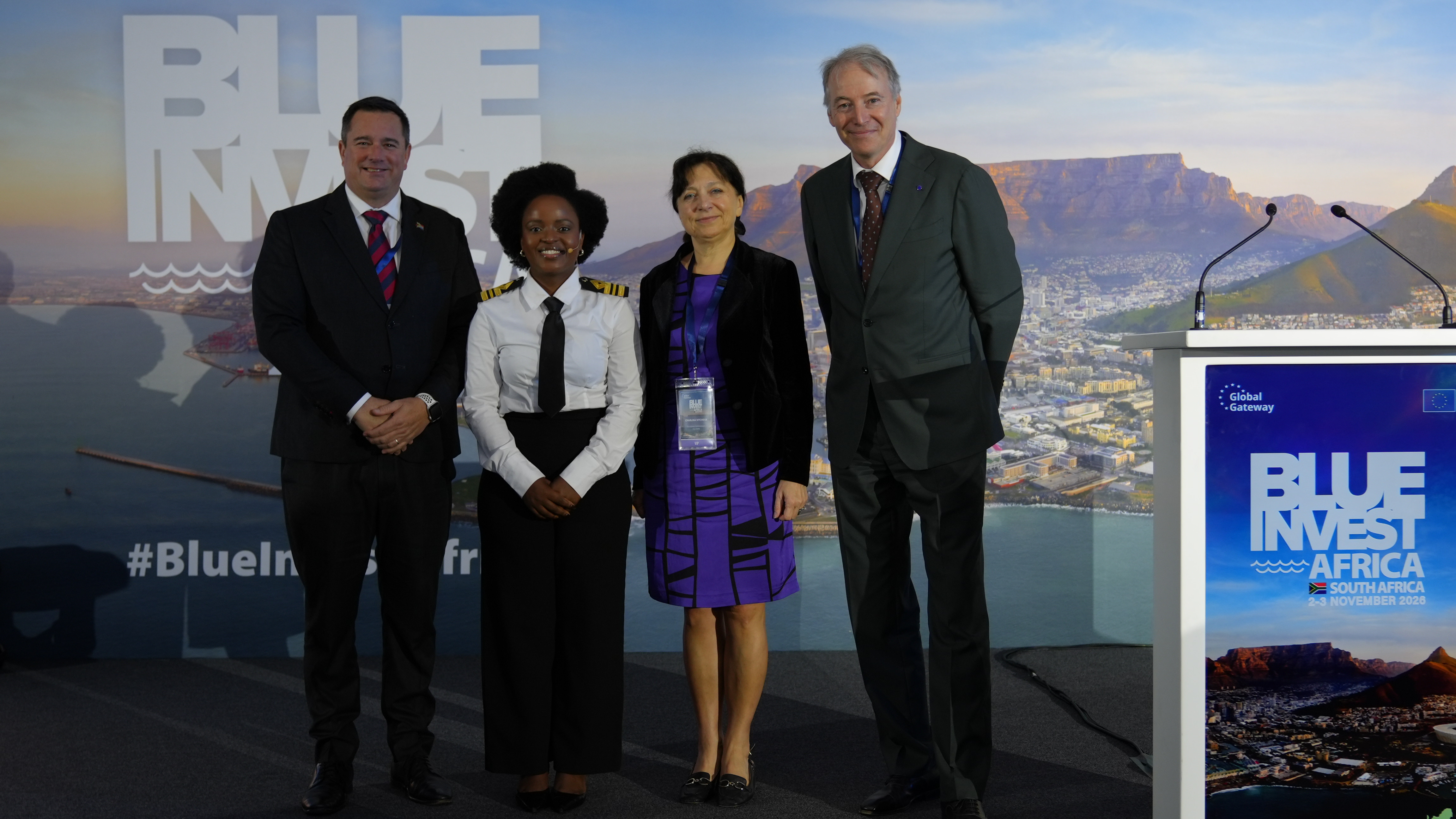
Cape Town, South Africa | 2 November 2026
Africa’s next economic frontier may not be found only beneath its soil, but across the vast waters that surround the continent.
That message is becoming increasingly difficult to ignore as investors, entrepreneurs, governments and development institutions gather in Cape Town for BlueInvest Africa 2026, taking place from 2–3 November.
The European Union’s flagship platform for Africa’s blue economy has brought together African innovators seeking capital with international investors looking for scalable opportunities across maritime industries, aquaculture, fisheries, marine technology, logistics, renewable energy and other ocean-related sectors. The 2026 edition follows hundreds of applications from 38 African countries, with 24 projects selected to pitch to investors.
But the significance of BlueInvest Africa extends beyond two days of presentations and networking.
It raises a much larger question:
Can Africa move from talking about the potential of its oceans to building the industries, companies, jobs and regional value chains capable of converting that potential into African wealth?
The message from the opening sessions in Cape Town was clear: the opportunity is enormous, but unlocking it will require investment, sustainability, industrial capacity and stronger African economic integration.
The ocean is an economic asset — but it must be protected
One of the strongest messages from the opening discussions came from Charlina Vitcheva, Director-General for Maritime Affairs and Fisheries at the European Commission.
Her central proposition was both simple and profound: the ocean sustains us, and therefore we must sustain the ocean.
This is an important starting point for Africa.
The blue economy cannot simply become another extraction story where African resources are commercialised while the continent captures only a small proportion of the value.
The objective must be sustainable economic development — creating businesses, industries, skills, technology and employment while protecting the marine ecosystems upon which future generations depend.
The European Commission has positioned BlueInvest Africa precisely at this intersection: connecting African entrepreneurship and innovation with the capital and investment expertise required to commercialise sustainable blue-economy solutions.
Hon John Steenhuisen: Africa must capture more value
Deputy Minister of Trade, Industry and Competition Hon John Steenhuisen brought the conversation directly into South Africa’s industrial and trade agenda.
South Africa has more than 3,000 kilometres of coastline, while approximately 98% of the country’s trade by volume moves by sea.
The economic opportunity is therefore not theoretical.
It is already embedded in the country's geography, infrastructure and industrial capabilities.
Steenhuisen highlighted the growth of South Africa's marine manufacturing sector. In 2025, exports of ships, boats and floating structures reached approximately R5.74 billion, representing growth of almost 130% since 2016. The recreational boat industry is another example. In 2024, exports exceeded R4.9 billion, with the sector directly employing more than 5,000 highly skilled South Africans.
These numbers demonstrate something important:
The blue economy is not simply about the ocean. It is about manufacturing, engineering, finance, technology, logistics, skills, exports and jobs.
That changes the conversation.
The question is no longer simply how much value exists in Africa's oceans.
The question is how much of that value can Africa capture, manufacture, finance and retain on the continent.
From national opportunity to regional value chains
Perhaps one of the most important interventions from Steenhuisen was his emphasis on regional industrial cooperation.
South Africa does not have to build the blue economy alone.
Angola, Mozambique, Namibia, Tanzania and other African coastal economies possess different resources, infrastructure, markets, skills and industrial capabilities.
Connecting these capabilities could create something much more powerful than isolated national industries.
It could create African blue-economy value chains.
Steenhuisen pointed to opportunities for collaboration in shipbuilding and invited Angola to explore greater industrial cooperation.
This is exactly the kind of thinking required if the Southern African Development Community (SADC) and the African Continental Free Trade Area (AfCFTA) are to become more than policy frameworks.
Imagine African shipyards sourcing components from neighbouring countries. Imagine African financial institutions financing African maritime companies.
Imagine African technology companies providing marine intelligence, logistics and monitoring systems across multiple markets.
Imagine African aquaculture companies scaling regionally rather than remaining trapped within individual national markets.
That is how an ocean economy becomes an industrial economy.
The Cape of Good Hope is becoming strategically more important
The geopolitical and logistical importance of the region is also changing.
EU Ambassador to South Africa Kristian Schmidt highlighted the growing strategic significance of maritime routes around the Cape of Good Hope and the importance of strengthening regional logistics networks.
This matters because global trade is increasingly confronting geopolitical uncertainty, supply-chain disruption and fragmentation.
The Cape route is not simply a geographic passage.
It is becoming an increasingly important component of global trade resilience.
For South Africa and the wider region, that creates both an opportunity and a responsibility.
Africa must ask whether it will merely provide the coastline, ports and transit routes for global commerce — or whether it will build the logistics, manufacturing, services, technology and financial ecosystems around those trade flows.
The real challenge: making African businesses investable
There is another important dimension to BlueInvest Africa.
Capital alone will not transform the blue economy.
Businesses must become investment-ready. One of the discussions surrounding the event is therefore focused on the gap between promising blue-economy businesses and the capital required to scale them.
A session hosted through GIZ's SWIOP-Invest and ProsperAzul programmes is examining investment readiness, access to finance and scaling opportunities for businesses in the Western Indian Ocean region. The discussion includes practical tools such as funding databases, AI-enabled matchmaking and investment-readiness resources.
This is critical.
Africa does not suffer from a shortage of ideas.
It often suffers from a shortage of investment-ready structures capable of translating ideas into scalable enterprises.
The next phase therefore requires entrepreneurs who understand capital, governance, markets, partnerships and scale — and investors who understand the realities and opportunities of African markets.
Beyond the conference room
The greatest measure of BlueInvest Africa will not be the number of speeches delivered over two days.
It will be what happens afterwards.
How many companies raise capital?
How many partnerships are signed?
How many technologies reach commercial scale?
How many African suppliers enter regional value chains?
How many jobs are created?
How much manufacturing capacity is built? And, ultimately, how much economic value remains in Africa?
That is the real test.
South Africa already has important foundations through initiatives such as Operation Phakisa's Oceans Economy programme and the Marine Manufacturing Development Plan, while projects such as Project Biro and Project Hotel demonstrate the country's existing industrial capabilities.
But government cannot do this alone.
As Steenhuisen emphasised, private investment, innovation and strategic partnerships are essential.
Africa must own more of its blue future
For decades, much of Africa's economic story has been framed around what lies beneath the ground.
Gold.
Platinum.
Copper.
Oil and gas.
Critical minerals.
But Africa's economic future is broader than its mineral wealth.
It includes its oceans, rivers, ports, fisheries, coastal cities, marine technologies, shipping routes and the millions of people whose livelihoods are connected to water.
The opportunity before Africa is to move from being a supplier of raw resources and a consumer of imported technologies to becoming a producer, owner, financier and exporter of blue-economy solutions.
That requires a new generation of African entrepreneurs. It requires patient capital.
It requires regional cooperation.
It requires world-class infrastructure.
It requires technology and skills.
And above all, it requires a different mindset about African economic opportunity.
We should not ask only what the world can extract from Africa's oceans.
We should ask:
What can Africa build from them?
That is why BlueInvest Africa matters.
It brings capital closer to entrepreneurs, connects Europe and Africa around practical investment opportunities, and creates a platform where innovation can meet finance.
But the bigger opportunity belongs to Africa itself.
The ocean economy can become a catalyst for industrialisation, regional trade, entrepreneurship and job creation — if African countries work together to ensure that a greater share of the value created from the continent's blue economy stays on the continent.
As Hon John Steenhuisen reminded international investors in Cape Town:
“Africa is open for business. Africa is open for investment. Africa is open for partnership.”
The next step is to make sure that partnership creates African ownership, African industries, African jobs and African prosperity.
Full article supplied by Oliver Chikodzore via Africa Rising TV.